

If you are looking for advice on how to clean dental implants, you already have implants, or you are planning to get them soon. Good. Implants are a lifetime investment, but only if you maintain them properly. I am Tom, a Melbourne-based technical expert with Turkish roots. I got my own All-on-6 implants in Turkey. Let me show you exactly how-to clean your implants properly, whether you have a single tooth or a full dual arch.
The Short Answer
Clean dental implants daily with a soft-bristle toothbrush, floss (or super floss for full arches), and a water flosser. Treat them like natural teeth, but pay extra attention to the gum line. After surgery, use a special post-op routine. With proper care, implants last 20+ years or a lifetime.
How-to Clean Dental Implants at Home (Daily Routine)
Whether you have a single implant or full arches, consistency is key. Here is your daily routine:
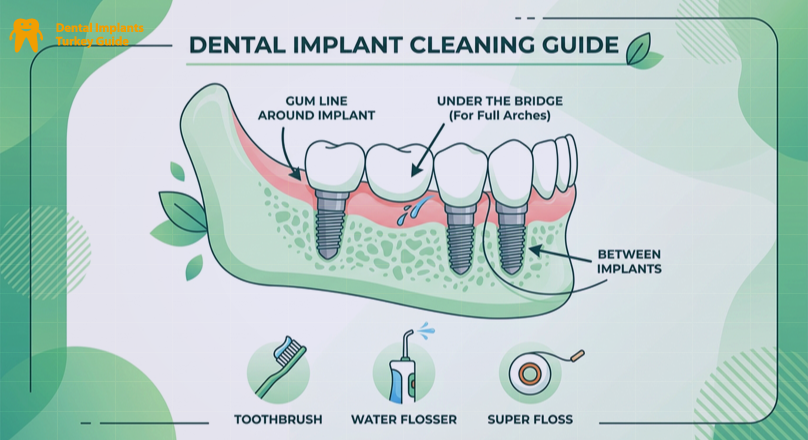
- Brush twice a day: Use a soft-bristle or extra-soft toothbrush. Electric toothbrushes are excellent. Pay special attention where the crown meets the gum line. Do not use hard bristles – they can scratch the crown surface.
- Floss daily: Use implant-specific floss or super floss. Wrap it around the implant crown in a C-shape and go slightly below the gum line. Do not snap the floss down – that can damage the gum seal.
- Water flosser (recommended): Aim the water jet at the gum line around each implant. This blasts away bacteria and food particles that brushing misses. Essential for full arches.
- Interdental brushes: Small brushes that fit between implants and natural teeth. Excellent for cleaning wider gaps.
- Non-abrasive toothpaste: Avoid whitening toothpaste or baking soda formulas – they can scratch porcelain crowns. Standard fluoride toothpaste is fine.
For Single Implants
Your routine is similar to natural teeth. Focus on flossing around the implant. A water flosser is optional but helpful. Total time: 3-4 minutes per day.
For Full Arches (All-on-4 or All-on-6)
Full arches require more work because the bridge is one solid piece. You cannot floss between teeth normally.
- Water flosser (essential): Use it daily. Aim under the bridge from the cheek side and tongue side. Spend 2 minutes total.
- Super floss: Thread it under the bridge from the cheek side. Pull it through and clean the gum line.
- Interdental brushes: Small brushes that fit under the bridge from the front.
- Electric toothbrush: Brush the bridge surfaces and the gum line on both sides.
Total time: 5-6 minutes per day. I do this every morning and evening. It becomes automatic after a few weeks.
How to Clean Dental Implants After Surgery (First 2 Weeks)
The first 14 days after implant surgery are critical. You must keep the area clean without disturbing healing. Follow these instructions carefully:
- Days 1-3: Do not brush the surgical site. Rinse gently with warm salt water (1 teaspoon salt in a glass of water) 3-4 times per day. Do not spit forcefully – let the water fall out of your mouth. Take prescribed antibiotics and painkillers as directed.
- Days 4-7: Begin gentle brushing of non-surgical areas. Use a child-sized soft toothbrush for the surgical site – very gentle strokes. Continue salt water rinses after meals.
- Days 7-14: Resume normal brushing but be gentle around the implant sites. Do not floss around implants yet. Continue salt water rinses. Avoid water flossers until stitches are removed (usually day 10-14).
- After stitches are removed: Begin using a water flosser on the lowest setting. Gradually increase pressure over the next week. Start flossing gently around implants.
What to avoid after surgery: No spitting, no drinking through straws, no smoking, no hot foods/drinks for 48 hours, no vigorous rinsing. These can dislodge the blood clot and cause dry socket or implant failure.
Do Dental Implants Require Special Cleaning?
Yes and no. The tools are the same – toothbrush, floss, water flosser. But the technique is slightly different:
- No metal scrapers: Never use metal dental tools on implants. They scratch the titanium or zirconia surface, allowing bacteria to accumulate.
- Plastic or carbon-fiber tools only: Your dentist or hygienist should use special implant-safe instruments during professional cleanings.
- Floss technique: Wrap floss in a C-shape around the implant, not a sawing motion. Sawing can damage the gum seal.
- Water flosser pressure: Start low and increase gradually. Too much pressure can force bacteria deeper into the gum pocket.
What Helps Dental Implants Heal Faster?
Healing (osseointegration) takes 3-6 months. You cannot rush bone growth, but you can create ideal conditions:
- Do not smoke: Smoking is the #1 cause of implant failure. Nicotine constricts blood vessels, starving the bone of oxygen. If you smoke, stop at least 2 weeks before surgery and during the entire healing period.
- Eat nutrient-rich soft foods: Protein shakes, yoghurt, smoothies, soup, scrambled eggs. Your body needs protein and vitamins (especially C and D) for bone healing.
- Stay hydrated: Water helps circulation and healing. Avoid alcohol – it dehydrates and interferes with medications.
- Follow your dentist’s medication schedule: Take all prescribed antibiotics (even if you feel fine) to prevent infection.
- Rest: Elevate your head when sleeping for the first 3-4 days to reduce swelling. Avoid strenuous exercise for 1 week.
- Use ice packs: 20 minutes on, 20 minutes off for the first 48 hours to reduce swelling.
What Happens to Dental Implants After 20 Years?
With proper care, here is what you can expect:
- The implant screw (titanium or zirconia): Should still be fully integrated with your bone. Success rates after 20 years are 95-98% for quality brands (Straumann, Nobel Biocare, BEGO).
- The crown or bridge on top: Likely needs replacement. Crowns typically last 10-15 years. At 20 years, you will probably need new crowns. This is normal maintenance.
- The gum tissue: Should be healthy if you maintained good hygiene. Without proper cleaning, you may have gum recession or peri-implantitis.
- Your bite: May have shifted slightly. Your dentist can adjust the crowns.
I know people with implants from the 1990s still going strong. Take care of them, and they will take care of you.
What Can I Use to Clean My Dental Implants?
Here is your approved cleaning toolkit:
- Soft-bristle toothbrush: Manual or electric (e.g., Oral-B, Philips Sonicare)
- Non-abrasive toothpaste: Standard fluoride toothpaste – no whitening, no baking soda
- Super floss or implant floss: Brands like Oral-B Super Floss or TePe Implant Floss
- Water flosser: Brands like Waterpik (use the implant tip or standard tip on low-medium pressure)
- Interdental brushes: TePe or similar – choose the right size for your gaps
- Mouthwash (optional): Alcohol-free, non-staining mouthwash. Avoid Listerine (alcohol can irritate gums).
- Salt water: For post-surgery rinses (1 tsp salt in warm water)
What to avoid: Metal scrapers, whitening toothpaste, baking soda, hard-bristle brushes, toothpicks (can damage gum tissue).
Common Mistakes That Damage Implants
- Skipping daily flossing: Bacteria accumulates between implants and gums, leading to peri-implantitis.
- Using metal tools at home: Scratches the implant surface.
- Chewing ice or hard objects: Cracks the crown.
- Grinding teeth without a night guard: Loosens crowns and damages implants.
- Smoking: Drastically increases failure rates.
- Skipping dental check-ups: Your dentist needs to monitor bone levels with X-rays every 1-2 years.
Let Us Talk
I am Tom. I got my own All-on-6 implants in Turkey. I am based in Melbourne, but if you’re thinking about going to Turkey for treatment, I can be your local guide. I can be there waiting for you. I do not work for clinics. I work for you.
Book Your Private Strategy Session
Frequently Asked Questions
How to Clean Dental Implants at Home
Brush twice daily with a soft-bristle toothbrush. Floss daily using implant-specific floss (wrap in a C-shape around the implant, not a sawing motion). Use a water flosser on low-medium pressure, aiming at the gum line. For full arches (All-on-4/All-on-6), a water flosser is essential – aim under the bridge. Total daily cleaning time: 5-6 minutes. Avoid whitening toothpaste, baking soda, and metal tools.
How to Clean Dental Implants After Surgery
Days 1-3: Do not brush the surgical site. Rinse gently with warm salt water (1 tsp salt per glass) 3-4 times daily. Do not spit – let water fall out. Days 4-7: Gently brush non-surgical areas; use a child-sized soft brush on surgical sites. Days 7-14: Resume normal brushing gently; do not floss around implants yet. After stitches removed (day 10-14): Begin water flosser on lowest setting; start gentle flossing. Avoid spitting, straws, smoking, and vigorous rinsing for 2 weeks.
Do dental implants require special cleaning?
Yes, compared to natural teeth (or even for Dental Crowns). You must use soft-bristle brushes and non-abrasive toothpaste. Never use metal dental tools on implants – they scratch the surface, allowing bacteria to accumulate. Floss in a C-shape, not a sawing motion. A water flosser is highly recommended. Your dentist or hygienist must use plastic or carbon-fiber tools for professional cleanings. With proper technique, cleaning takes 5-6 minutes daily.
What happens to dental implants after 20 years?
With proper care, the titanium implant screw should still be fully integrated with your bone (95-98% success rate). The crown or bridge on top will likely need replacement – crowns typically last 10-15 years. Gum tissue should be healthy if you maintained good hygiene. Your bite may have shifted slightly. Regular dental check-ups (every 6-12 months) and X-rays (every 1-2 years) are essential to monitor bone levels. I know people with implants from the 1990s still going strong.
What can I use to clean my dental implants?
Use a soft-bristle or electric toothbrush, non-abrasive fluoride toothpaste (no whitening, no baking soda), super floss or implant floss, a water flosser (essential for full arches), and interdental brushes. For post-surgery: warm salt water (1 tsp salt per glass). Avoid metal scrapers, whitening toothpaste, hard-bristle brushes, toothpicks, and alcohol-based mouthwash (Listerine can irritate gums).
What helps dental implants heal faster?
Do not smoke – it is the #1 cause of implant failure. Eat nutrient-rich soft foods (protein shakes, yoghurt, soup). Stay hydrated and avoid alcohol. Take all prescribed antibiotics. Rest with your head elevated for 3-4 days. Use ice packs (20 minutes on, 20 minutes off) at least for 48 hours. Avoid strenuous exercise for 1 week. You cannot speed up bone growth (osseointegration takes 3-6 months), but you can create ideal healing conditions.